Dust, Debris, and Concrete Splashes: Is Your Eyewash Where the Risk Is?

BLOG ARTICLES

Construction sites generate constant airborne hazards, but eyewash access is often an afterthought. When eye injuries happen, seconds matter. If eyewash isn’t immediately accessible, a minor incident can quickly turn into permanent damage or lost productivity.  

Is your eyewash where the risk actually is?  

Why “Point of Risk” Matters More Than Ever 

Eye injuries worsen rapidly if contaminants aren’t flushed away right away. Every second increases the likelihood of: 

  • Corneal abrasions 

  • Chemical burns 

  • Infections 

  • Vision impairment 

  • Recordable incidents and claims 

ANSI Z358.1 emphasizes that emergency eyewash equipment must be accessible within 10 seconds without delay, per the standard. On dynamic construction sites where work zones shift daily, fixed or plumbed eyewash can’t keep up. 

The Reality of Eye Hazards on Construction Sites 

Eye hazards in construction are constant and built into the work itself. Common risks include: 

  • Airborne dust from cutting, grinding, drilling, or demo work 

  • Concrete splash during mixing, pouring, or finishing 

  • Flying debris from power tools and heavy equipment 

  • Wind-blown particles on open sites 

Even with proper PPE, exposure still happens; goggles shift, visibility drops, and incidents occur in seconds. OSHA and ANSI require immediate access to eyewash for a reason: delayed responses increase injury severity.  

The Gap: “We Have Eyewash” vs. “We Can Use It Immediately” 

Many safety managers assume they’re covered because there’s an eyewash station somewhere on site. But when you test that assumption, gaps often appear: 

  • The eyewash is inside a trailer, not near the task 

  • It requires plumbing, making relocation impractical 

  • It’s blocked by equipment or materials 

  • Workers aren’t sure where it is 

  • Activation requires two hands, limiting effective flushing  

  • Distance exceeds safe response time 

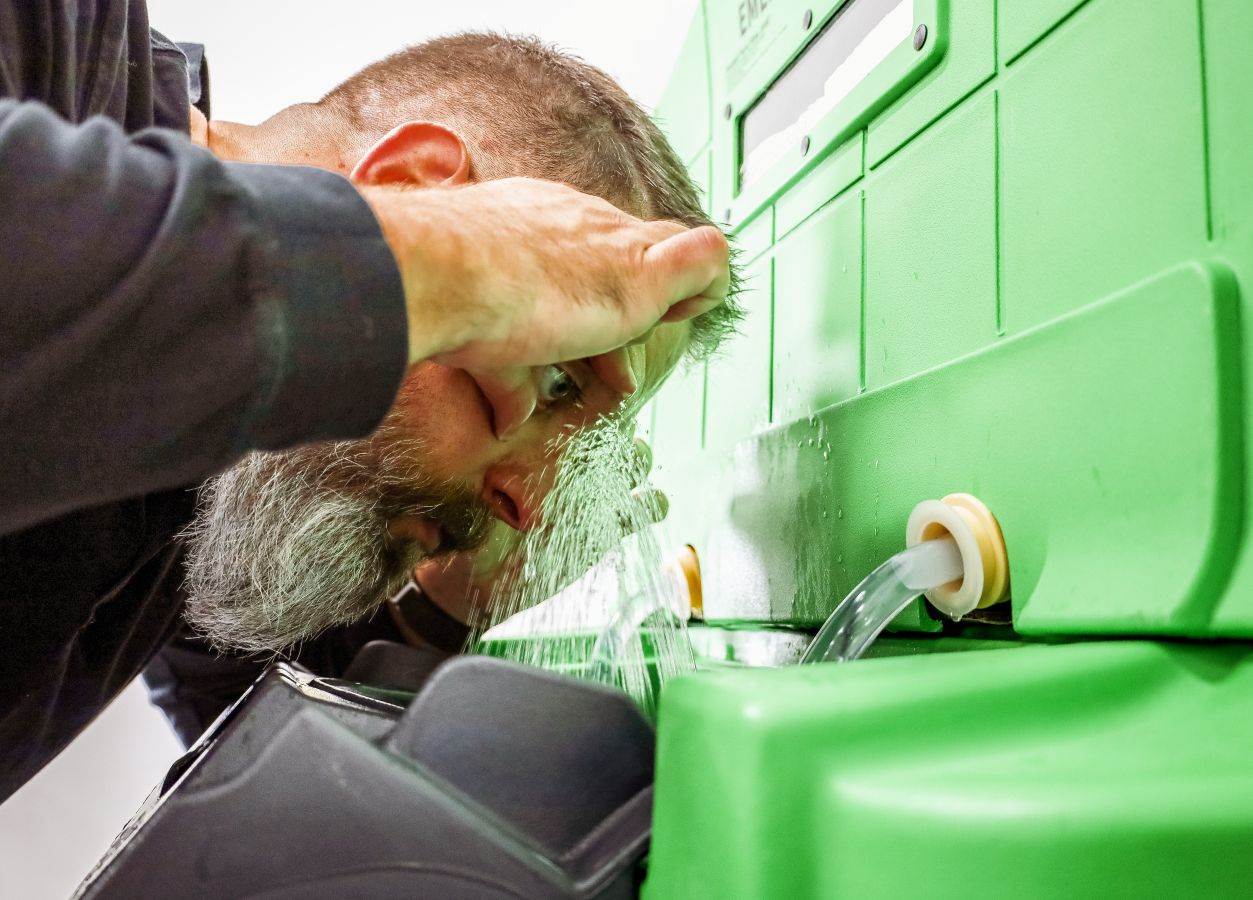
When a worker has dust, concrete, or chemicals in their eyes, they shouldn’t be navigating obstacles or running across a job site. They should be flushing immediately, hands free, right where the exposure occurred. That’s where portable, self-contained solutions change the equation. 

The Hero Solution: Fendall® Pure Flow 1000® Emergency Eyewash Station  

The Fendall® Pure Flow 1000® Emergency Eyewash Station was built for environments where mobility, reliability, and speed matter most. 

Why It Works at the Point of Risk: 

  • Portable and Self-Contained 
    Can be placed exactly where high-risk tasks occur and moved as job evolves. 

  • Hands-Free Operation 
    Workers can hold their eyes open and focus on flushing properly. 

  • Sealed, Preserved Fluid 
    The self-contained system protects fluid integrity and eliminates mixing or maintenance guesswork. 

  • Consistent Flow for Emergency Response 
    Provides a controlled, effective flush when every second counts. 

  • Built for Dynamic Job Sites 
    From demo zones to remote work areas, it goes where plumbed systems can’t. 

A Quick Self-Audit for Safety Managers 

  • Ask yourself, and your supervisors, these questions: 

  • If an eye exposure happens right now, could the worker flush immediately? 

  • Is eyewash located within 10 seconds of cutting, pouring, or mixing activities? 

  • Can stations be easily relocated as work zones shift? 

  • Is activation truly hands free? 

  • Do workers know exactly where it is without thinking? 

If any answers are “no” or “not always,” it’s time to re-evaluate. 

Eyewash Isn’t About Compliance, It’s About Outcomes 

  • A well-placed eyewash station can mean the difference between: 

  • A near-miss and a recordable injury 

  • A quick rinse and a workers’ comp claim 

  • A protected worker and a lifelong injury 

Hazards are mobile. Your emergency response should be too. 

Final Thought: Put Protection Where the Risk Lives 

Eye hazards aren’t confined to trailers or permanent structures. They happen at the saw, the pour, the cut, and the mix. 

If your eyewash isn’t there too, it’s not truly protecting your team. 

The Fendall® Pure Flow 1000® Emergency Eyewash Station helps safety managers close the gap, bringing immediate, hands-free response directly to the point of risk. 

Is yours? 

To safeguard against debris-related eye injuries, check out our eyewash solutions. 

MORE ARTICLES

The Psychology Behind Effective Food Safety Culture

What’s the first thing you think of when you see a firefighter helmet? If your answer was hero, rescue, save, protect or first responder, you’d be in line with the majority of Americans. The…

READ MORE

Understanding The Differences Between Antimicrobial, Antiviral and Antibacterial Hand Protection

ANTIMICROBIAL - ANTIVIRAL - ANTIBACTERIAL: What Does This All Mean for Hand Protection? by Anthony Di Giovanni, Vice President of Global Marketing Safety managers are demanding PPE tha…

READ MORE

Reusable vs. Disposable – Using The Right Garment For The Right Job

Disposable garments or reusable garments – which choice is right for you? There has always been back-and-forth about whether reusable or disposable garments are best for the workplace. Safety ma…

READ MORE
Compare ()
Clear All Compare
Okay, Got it.